
Track Marana Previous Residents
A complete search moves from the newest parcel evidence toward older occupant sources. The current Assessor card supplies the stable parcel number and legal description. The Recorder's documents carry ownership backward. Directories and census schedules answer the separate question of who occupied the place. Marana town material starts with incorporation-era records, while regional and state collections reach farther back.
| Source | Years It Covers | Where Held | What It Shows |
|---|---|---|---|
| Assessor parcel roll | Current roll and displayed sales or valuation history | Pima County Assessor | Owner, mailing and situs addresses, parcel, legal description, and property traits |
| Recorded documents | County records from 1865; June 1982 forward fully indexed online | Pima County Recorder online and office | Grantor, grantee, instrument, date, legal parcel, and document image |
| Tucson directories | Existing editions from 1881 through 2003 | PCPL, Arizona Historical Society, and Arizona Memory | Named occupants, occupations, spouse or address details, with reverse sections in some years |
| Federal census | Public through 1950 | National Archives and library genealogy databases | Household members, relationships, ages, birthplaces, and occupations |
| Marana municipal records | Selected archive series from 1977; permit depth varies | Town archive and public-record request | Planning context, permit applicant, contractor, work, date, and address when releasable |
For a recent deed, start online. For a household from the mid-twentieth century, pair the parcel with a reverse directory and the released census. Older rural land may call for Recorder office indexes, assessment rolls, Great Registers, and township-and-range references at the State Archives.
Start Marana Resident History Today
Open the Pima County Assessor parcel search and search the street address. The system also supports owner, parcel code, map and plat, recorded document, subdivision, and Public Land Survey System modes. Copy the parcel code, current owner, tax mailing address, physical or situs address, legal description, and current deed reference before moving on.
The situs is the land's physical location. The mailing address is where the tax bill goes. A difference may point to an owner elsewhere, a post office box, a trust, or old account data. A match may support owner occupancy, but it does not prove it. Past residents and title owners are distinct groups.
Stable-key tip. Keep the parcel number and legal description beside every result; they survive spelling changes and uncertain postal city labels.
Trace Marana Past Residents by Deed
The Recorder's index is organized around parties and recorded instruments, not a household list. Begin with the current acquisition deed. A grantor gives or sells an interest; a grantee receives it. Search the seller as a grantee in an earlier date range, then confirm that the legal description matches. Do not mistake a deed of trust, release, lien, or easement for a sale.
- Use the Assessor card to identify the present owner, parcel, subdivision or lot, and recorded-document reference.
- Open the acquisition deed in the Pima Recorder Public Search. Record parties, execution and recording dates, sequence or book and page, and legal description.
- Search the seller or grantor as a grantee before that transfer. Use last name first, omit punctuation, and try a surname alone if the index misses a variant.
- Confirm the same parcel or legal land description. Then repeat the search with the prior seller.
- When the digital index stops, carry later book-and-page references to an office kiosk or a precise mail or counter request.
Online coverage is complete from June 1982 forward. Pima County records reach 1865, but older historic indexing remains incomplete and is released over time. A blank online result is not proof that no transfer occurred.
- Grantor and grantee
- The party giving an interest and the party receiving it.
- Chain of title
- The linked series of recorded ownership transfers for the same land.
- Legal description
- The recorded lot, subdivision, PLSS, or metes-and-bounds wording that identifies land apart from its postal address.
- Sequence or book and page
- A filing reference used to retrieve one recorded document directly.
Bridge Marana Address Records Backward
The Recorder offers free unofficial low-resolution images with a watermark. Clean copies may be bought online or at the office. The official fee schedule lists letter-size images at $0.25, digital copies at $0.25 per document, certified copies at $1 per image plus a $3 seal, mail processing at $1 per document, and a 2 percent online card fee. Buy certification only when a formal use requires it.
When an old instrument is not indexed online, use the document references recited in later deeds. The downtown research office is at 240 N. Stone Avenue in Tucson, open weekdays from 8 a.m. to 5 p.m., with help at 520-724-4350. The Eastside office at 6920 E. Broadway Boulevard, Suite D, has limited service from 8 a.m. to 4:30 p.m. and closes from noon to 1 p.m. Mail requests go to PO Box 3145, Tucson, AZ 85702-3145 with the sequence or docket and page, names, recording date, and a phone number.
Most Marana parcels are in Pima County, but a small northern edge reaches Pinal County. Confirm jurisdiction before searching. USPS wording alone cannot settle which Recorder holds the deed.
Note: The office route is essential for some historic Marana address records because digitization is continuing rather than complete.
Find Marana Occupants in Directories
A deed gives ownership, not a full household. Reverse directories can name an occupant at an address, including someone absent from the tax roll. Pima County Public Library holds historical print and microfilm directories at Joel D. Valdez Main Library. Its Cele Peterson Arizona Collection includes Cole and Polk reverse directories, telephone books, and regional newspaper microfilm.
PCPL Infoline at 520-791-4010 will perform a free criss-cross lookup for up to three addresses or telephone numbers. This is the strongest remote fallback when a needed volume is not digitized. Ask for a precise address and a narrow date range. Directory editions were not annual, and some reverse volumes were rentals later returned to publishers.
The collection years, entry conventions, and shelf gaps are treated in full on the Marana city directories page. For previous residents, capture only the occupant evidence needed for the address timeline, then reconcile it with title and census records.
Pair Marana Residents with Census
The census adds relationships, ages, birthplaces, and occupations to a directory name. Federal schedules open after 72 years, making 1950 the latest public census. Historical Marana households may appear under a rural Pima precinct or enumeration district rather than today's town boundary. An enumeration district is the area assigned to one census taker.
The National Archives census research portal describes the released schedules and search paths.
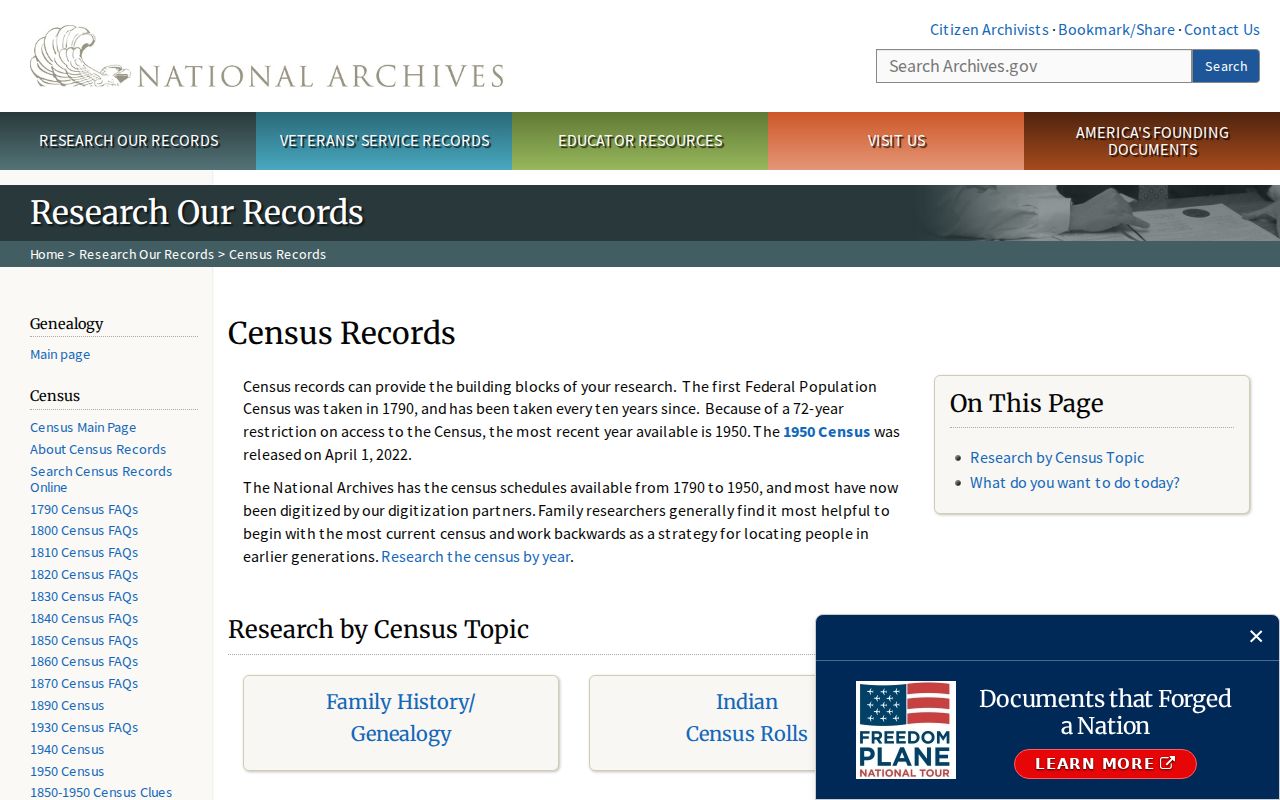
The federal screen provides the census route, but the search still depends on period geography. Use the nearest available directory address, route, precinct, and neighboring households to test a match.
- Choose the directory edition nearest 1940 or 1950 and transcribe the listed name and address.
- Search that census by name, then narrow with Pima County, age, birthplace, spouse, or child.
- Read the full household and nearby enumeration lines. The taker's path may cross a road or rural tract.
- Compare the census household with the next available directory and the parcel deed. Mark conflicts instead of forcing a match.
- Use newspapers, vital records, and probate to explain a death, remarriage, move, or name change.
Date Marana Homes Through Records
The Assessor card can supply construction traits, sales references, maps, and image links. Town permits may add the applicant, contractor, scope, valuation, dates, and project address when those fields are public. Marana's online archive begins with selected records from incorporation in 1977, but building permits and development plans outside that archive require a separate request.
The Town of Marana heritage timeline places the address trail within local development history.
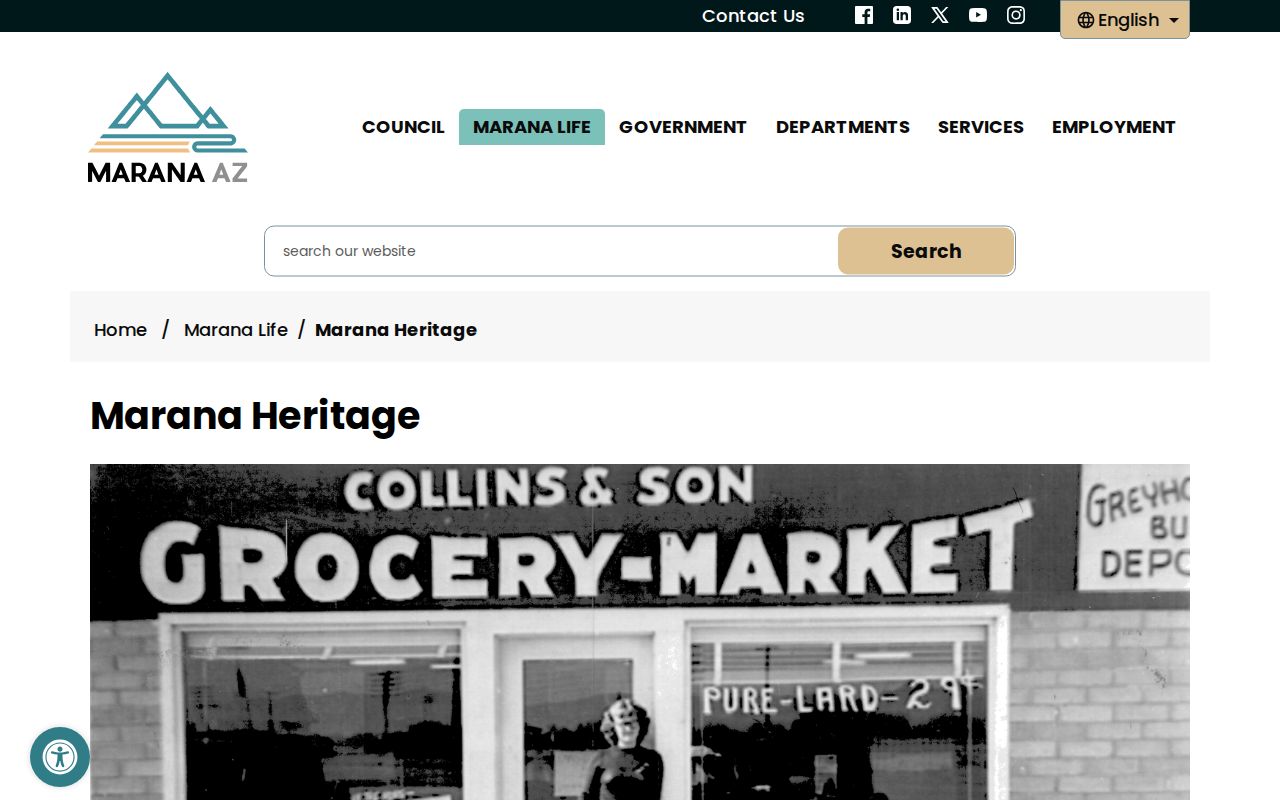
The Town's heritage view helps distinguish long rural and agricultural history from the municipality's newer archive. It does not identify a household by itself.
Marana announced a CityView service rollout for summer 2026 covering permits, code, licenses, property, real property, and water-meter work. During the transition, keep the Town public-record request as the fallback. Under A.R.S. §39-121.01, ask for a known record series, address, and date range rather than every possible file.
Close Marana Resident Trails
A last directory appearance can mark a move, death, omission, or a missing edition. PCPL's Arizona Daily Star and Tucson Citizen microfilm can supply weddings, school lists, civic clubs, legal notices, businesses, and obituaries. Confirm key facts in a government record. Historical Arizona birth images open after 75 years and death images after 50 years, while recent certificates remain limited to eligible applicants.
For a deceased owner, a Pima County probate file and later personal-representative or beneficiary deed may connect heirs with the next transfer. Probate is excluded from the statewide Public Access portal, so use the Pima County Clerk of Superior Court case-record route. A marriage license or court file can also explain a surname shift. Sealed or restricted facts remain closed.
The Arizona State Archives genealogy collection adds Great Registers, assessment rolls, courts, probate, marriage records, territorial prison records, and newspapers. Many groups require catalog or onsite work. They are especially useful before Marana's 1977 archive breakpoint.
Protect Marana Previous Residents
House history supports genealogy, heir research, preservation, and personal curiosity. It does not justify following, contacting, or exposing a living person. Arizona's Address Confidentiality Program uses substitute addresses for eligible protected people, and voter, court, police, and motor-vehicle records suppress sensitive fields under their own laws.
Lawful use. Use Marana previous-resident records for legitimate research, and never use an address trail to stalk, harass, threaten, or harm anyone.
Absence can be meaningful without being a clue to defeat. It may reflect a renter, a rural household, an unpublished year, an index gap, a sealed file, or a protected address. State research found no verified dedicated Sanborn map sheet for historic Marana and no confirmed mass renumbering event. Do not invent either one. Bridge address changes with plats, Assessor maps, legal descriptions, dated directories, and known record references.
For today's full address chain, including parcel and GIS methods along a named road, use the Marana by-street directory. A backward trail stays focused on one parcel and marks every inference as an inference.