
Explore Marana Directory Collections
No single shelf is a complete Marana city directory. The sound collection is regional. Pima County Public Library, the Arizona Historical Society, and online collections together hold the Tucson directories that may name Marana-area residents. County assessment rolls, the federal census, and the post-incorporation town archive cover people who never entered a commercial volume. The dates below state what the research confirms, without treating a gap as proof that a person was absent.
| Collection | Years | Where Held | Access |
|---|---|---|---|
| Tucson city directories | Existing editions, 1881 through 2003 | PCPL, Arizona Historical Society, and online sources combined | Print, microfilm, and selected digital access |
| 1881 Directory of the City of Tucson | 1881, reprinted in 1988 | Arizona Memory Project | Free digitized PDF |
| Cole and Polk reverse directories | Various twentieth-century editions | Joel D. Valdez Main Library | Noncirculating reference and Infoline help |
| Tucson telephone directories | Current and historical volumes | Joel D. Valdez Main Library | Reference use |
| Federal census schedules | Public through 1950 | NARA and library genealogy databases | Released after 72 years |
| Marana town archive | Selected series from 1977 forward | Town of Marana | Free archive; other records by request |
The strongest starting point depends on the era. Use the Town archive for selected council, code, planning, and finance records after incorporation. Use Tucson directories, newspapers, county rolls, and census schedules for earlier residents. For territorial or early statehood research, the Arizona State Archives adds Great Registers, assessment rolls, probate, court, and marriage record groups that may not be online.
Marana Within Tucson's Directory Orbit
Pima County began as one of Arizona Territory's original counties in 1864, with Tucson as its records center. Marana stayed rural and agricultural through much of the era when commercial directories focused on compact urban households. It incorporated in 1977. That timeline explains why a Marana ancestor can be indexed under Tucson, rural Pima County, a precinct, a post route, or a township-and-range land description.
A modern town label should not be imposed on an old entry. The Santa Cruz River corridor, farm districts, railroad and highway growth, and later communities such as Continental Ranch, Dove Mountain, Gladden Farms, and San Lucas entered the record at different times. Agricultural workers, renters, and Indigenous residents may be faint in property and directory sources. Census, school, church, newspaper, and oral-history collections can restore part of that missing view.
Marana's incorporated boundary also reaches toward a small Pinal County edge. A postal label is not a records jurisdiction. When a directory address leads to land or court research, confirm the county before ordering a file.
Marana's 1881 Directory Window
The earliest directory specifically verified in the local research is the 1881 Tucson volume. It predates the telephone as its organizing idea. Its title promises a list of residents, occupations, and places of residence, then adds public officials, Fort Lowell officers, schools, churches, societies, banks, and newspapers. For a Marana family tied to the Pima County hub, the volume gives both a person and the civic world around that person.
The digitized 1881 Tucson directory can be read online through the Arizona Memory Project. Search the alphabetical names, but also inspect the front matter and institutional lists. A missed personal entry may still leave an employer, church, post, school, or trade clue.
That broad civic inventory makes the image useful beyond a name hit. It shows what one early city directory meant before a town of Marana directory existed.
Access Marana Directories at Valdez
The main physical shelf is the Cele Peterson Arizona Collection on the third floor of Joel D. Valdez Main Library in Tucson. The collection is noncirculating, so materials stay in the library, though photocopying is available. Its southern Arizona focus includes Cole and Polk reverse and city directories, Tucson telephone books, Arizona history, and Arizona Daily Star and Tucson Citizen microfilm from the late 1800s forward.
The Pima County Public Library directory service page explains the routes available to local and remote researchers.
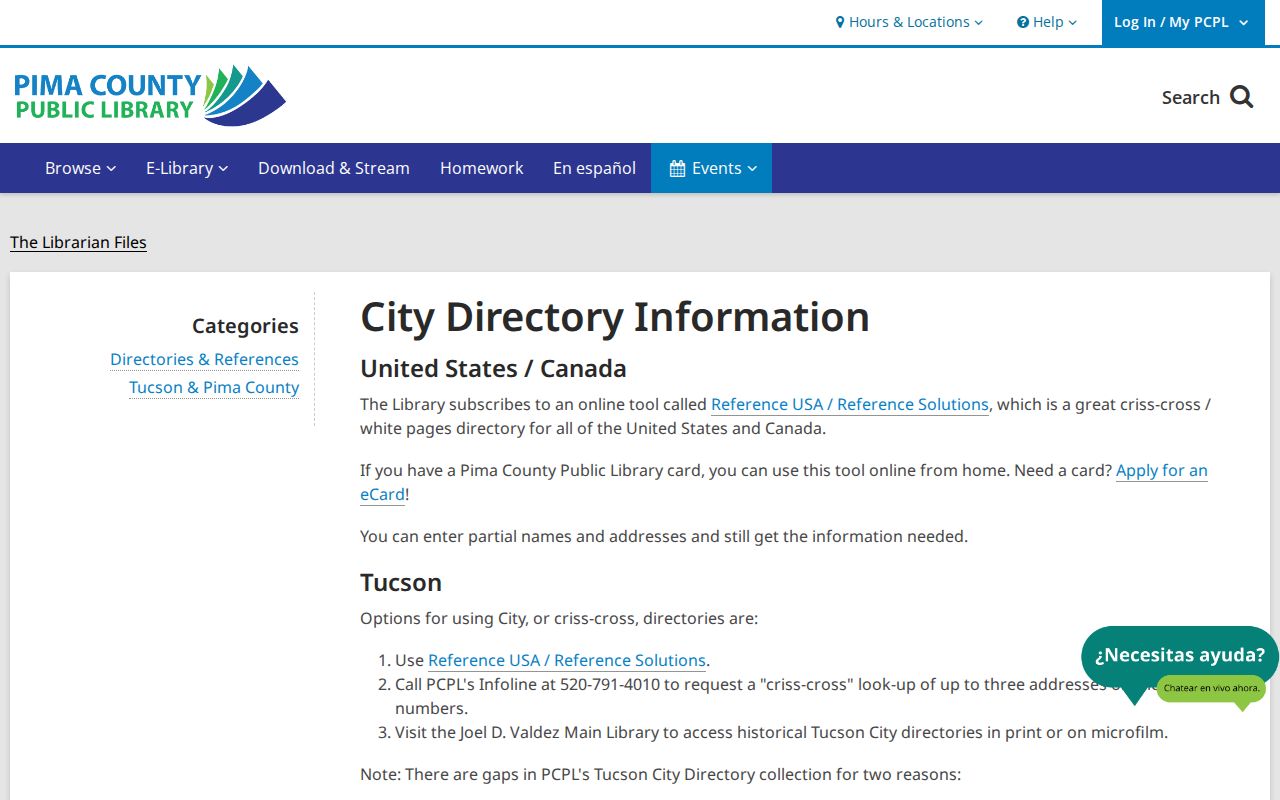
The library screen is the gateway, not the whole collection. A cardholder may use Reference Solutions from home with partial names or addresses. Someone without a visit can call Infoline at 520-791-4010 for a free criss-cross lookup covering up to three addresses or telephone numbers.
Remote-search tip. Give Infoline the exact address, likely year range, and any former telephone number so staff can select the right volume.
Explain Marana Directory Shelf Gaps
A blank year needs care. Directories were not issued every year. PCPL also notes that some reverse-directory volumes were rentals that went back to their publishers. A missing book may reflect publication or retention, not a destroyed courthouse record and not a household's departure. No documented Pima County courthouse-fire gap supports adding such a story here.
The library's 2024 directory history says PCPL, the Arizona Historical Society, and online sources collectively provide access to every Tucson directory year known to exist through 2003.
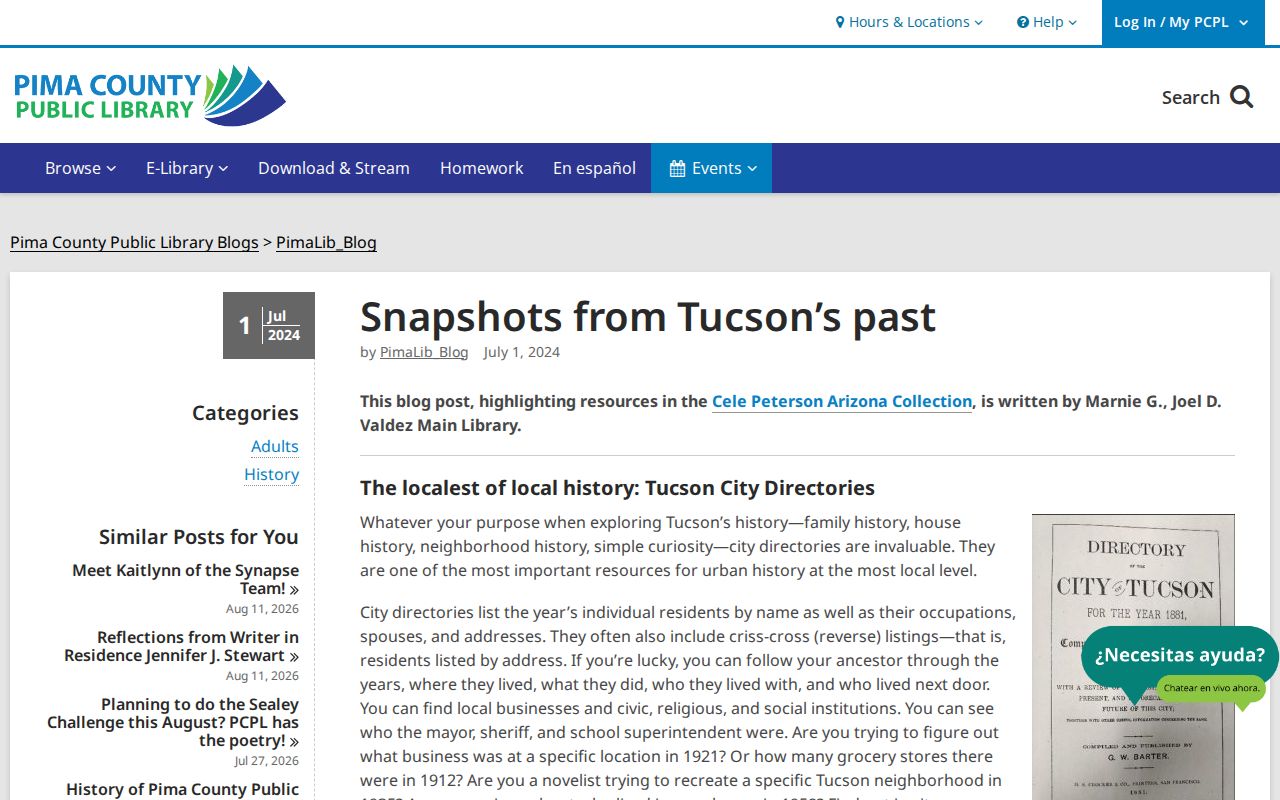
The guide turns a gap into a search cue. Check the next available edition, ask which institution holds it, and use a census or newspaper for the interval.
Note: A missing Marana directory entry can mean omission, rural residence, a spelling variant, an unpublished year, or a returned rental volume.
Read Marana City Directory Entries
An 1881 personal line normally compresses surname, given name or initial, occupation or status, and residence into a short entry. Later Polk and Cole volumes may add a spouse in parentheses, an employer, a street number, a homeowner or renter mark, or a widow notation. Those later conventions must be checked in the volume at hand. They should not be projected backward onto the 1881 book.
| Indexed name | Read initials, suffixes, compound surnames, and spelling variants exactly as printed. |
|---|---|
| Occupation or status | A dated affiliation that can point to payroll, trade, or newspaper records. |
| Spouse or widow note | A relationship clue found in some later editions, subject to that publisher's key. |
| Residence | The listed place or street address for that edition, not proof of title ownership. |
| Owner or renter mark | A symbol used by some runs and meaningful only after reading the key. |
Southern Arizona names often use two surnames, a hyphen, maiden and married forms, initials, or anglicized variants. Search each form. A terse line can be wrong or stale, so compare it with another dated source.
- Criss-cross directory
- A reverse section arranged by street address or telephone number instead of surname.
- Householder index
- A list centered on a household head or address, with coverage set by the publisher.
- Abbreviation key
- The volume's own legend for short forms and symbols. Photograph or transcribe it before interpreting entries.
Search Marana Directories by Address
Later reverse listings reorder the city directory by street and house number. This is the bridge from a known place to a named occupant. Scan the target number, the addresses beside it, and any repeated unit notation. One result may identify a person who rented and never appeared on the parcel roll. It may also show a business at the same address.
Address text changes. Marana's growth produced new plats and streets, while older rural records may use routes, landmarks, township and range, or a subdivision name. No verified mass street-renumbering event was found. Use a parcel number, plat, legal description, or dated map to link old and new wording. Modern address-keyed records belong in the Marana street directory workflow.
Trace Marana Family Directory Years
Directory years work best as a sequence. Each entry is dated evidence, not a full biography. Census schedules add relationships, ages, and birthplaces that a city directory tends to omit. Newspapers and deeds can then explain a move, death, or change of name.
- Choose an exact edition and read its publisher key before copying any mark.
- Search the surname, initials, two-surname forms, and likely spelling variants. Record the occupation, spouse, and address exactly.
- Check the reverse section when one exists. Note adjacent numbers, units, and other people at the address.
- Move one available volume backward and forward. Treat first and last appearances as brackets, not exact move dates.
- Pair 1940 and 1950 entries with the released federal census. Compare household members, ages, birthplaces, and work.
- Anchor the address to a parcel or deed, then use obituaries, probate, vital records, and later directories to resolve a disappearance. Arizona's A.R.S. §36-351 sets the 75-year birth and 50-year death genealogy-release rules.
A directory occupant may differ from the deed owner. That is useful evidence, especially for relatives and renters who leave no ownership line. For a modern name that follows the historical trail, use the Marana resident lookup and require a second independent match.
Extend Marana Directory Research
Three dates organize the Marana city directory trail. They mark the earliest verified volume, the start of the Town's own archive, and the end point of the combined directory run described by PCPL.
| Date | Research turning point |
|---|---|
| 1881 | Earliest specifically verified Tucson directory, now available as a digitized volume. |
| 1977 | Marana incorporated; selected Town council, code, planning, and financial archive series begin. |
| 2003 | Latest year in the combined run of existing Tucson directories described by PCPL's 2024 guide. |
Beyond those points, use the record best suited to the question. The Arizona Historical Society Library and Archives offers catalog and reference access in Tucson. The Arizona State Archives genealogy collection adds Great Registers, assessment rolls, court, probate, marriage, prison, and newspaper material. PCPL newspaper microfilm can connect a Marana address with weddings, school events, civic clubs, legal notices, and obituaries.
Keep each conclusion narrow. A directory shows a listing at a point in time. A census shows a household on its enumeration date. A deed shows an ownership act. Together, they form a much stronger family history than any one index.